Showing posts with label Miss Cather. Show all posts

Friday, May 10, 2013

[S]he loved youth

Of the Professor in The Professor's House, Willa Cather writes "... he loved youth-- he was weak to it, it kindled him.  If there was one eager eye, one critical, doubting mind, one lively curiosity in a whole lecture room full of commonplace boys and girls, he was its servant.  That ardour could command him. It hadn't worn out with years, this responsiveness, any more than the magnetic currents wear out; it had nothing to do with Time."

I think about this all the time when I am walking around campus.  Especially on nice days.  I know what this is like.  There are so many reasons to love working on a college campus, but for me, being surrounded by kids who are at this stage in their lives is one of the best.

I made my campus visits as a high school senior.  I only visited schools that had already admitted me, so there was no anxiety about it.  I was making the most exciting decision of my life.  The weather was beautiful at all three of them: Valparaiso, Wake Forest, and Furman.  I could not wait for college to begin, because it felt like waiting for my real life to begin.  When I walk around Maryland's campus on a beautiful day, I can remember exactly what that felt like.  How beautiful and exciting everything was.  How cool college kids seemed and how much freedom they had.  How much fun they seemed to be having just walking around.  I think about how that "lively curiosity" college students have was inspiring when I was 17 and continues to be refreshing now that I'm 30.

Today was a beautiful day on campus, so I took a few pictures on my walking commute.


It's a rough life, right?

Somewhat relatedly, I took Nora to campus with me yesterday for my department's end of semester party.  This deserves a post of its own, but it's been a long week, so I'll keep it short:  It was a delight to see her in my work element.  I thought she would run around the mall, but she mostly stood in place and stared all around her.  My friends and professors were very excited to see her, and after about an hour of shyness she warmed up to the situation enough to show off her personality a little.  I'm at a stage in my program where I don't have much interaction with other members of the department unless I actively seek it out, and that's hard to do with so little spare time in my schedule.  It was extra nice to have everyone together in one place, to hear briefly how they've been doing, and to let them see that my current "project" is not limited to reading, writing, and teaching.


Thursday, June 9, 2011

The Walking Woman

I have been reading Mama, PhD,  the book whose title I borrowed for my pregnancy announcement post.  In the book, many women write about various struggles they have encountered in trying to balance the desire to be a mother with the desire to be an academic.  The problem that keeps showing up from different women, in different disciplines, is that academia expects its members to behave as if they are disembodied minds which focus solely on their work.  I have also found that the expectations of academia suggest the “best” academics are wholly absorbed in their intellectual work, unhindered by the presence of their bodies, and not distracted by the influences of everyday life.  Every graduate student, I imagine, has heard some variation of the phrase "You're in graduate school; you're not allowed to have a life" from a professor at some point.  It seems pretty obvious to me that this results from the discipline’s predominantly male past, and Cather’s The Professor’s House demonstrates one example of what this looks like. The professor has an isolated study in his home where he performs his work, while his wife cares for his growing daughters in the house below.  He engages with them during prescribed times every week, but for the most part, his wife is responsible for keeping the family and the home running.  He ignores hunger and cold because venturing out of his study to eat or get warm leaves him susceptible to familial distractions.  He even remembers fondly that his favorite daughter sat outside his office when she was 8, waiting for him to finish his work before she told him she had been stung by a bee.

Since I began graduate school, I have been pressing up against the limits of the unreasonable expectation that academics should prioritize their work even at the expense of other aspects of their lives.  My work has been a top priority for me these past three years, but it has not been my only priority.  I am happily married, my husband and I are currently unwilling to move away from the house we own, and though I have good friends in my program, I insist on trying to maintain relationships outside my academic life.  With one exception, I managed to schedule my classes each term so that I’d never have to be away from my husband more than two nights a week.  I have carefully selected as mentors those professors who care about me as a whole person, and I often disregard the opinions of those who suggest I should devote even more of my time or energy to my academics.  I know myself, and I know that if all I did was school, I’d burn extra bright for a short period of time before burning out.  Attempting to maintain a balanced life helps me to keep enough fuel in my various fires for them to burn at a more sustainable rate.

So far, I have been largely successful in managing the work/home balance, if only because those in my domestic life are so supportive of my academic priorities. I love Billy more today than I did when I began graduate school. The patience and support he has shown for my dedication to my work has better revealed to me what an excellent man and husband he is. I almost always feel like a good academic, and I usually feel like a good wife. But I realize, and I worry, that choosing to have the baby could upset this balance and leave me feeling like I am not a good wife, mother, or academic.  The traditional expectations for these three roles are mutually exclusive in a variety of ways.  The women who’ve written in the Mama, PhD anthology suggest this fear is not an unreasonable or unusual one.

This anxiety makes me reflect on the story that allowed me to give myself permission to have the baby as a graduate student.  That story is Mary Austin’s “The Walking Woman,” in which the title character shares her tales of living, loving, and mothering in the desert with the short story’s narrator.  After talking with the Walking Woman, the narrator concludes that there are three things a woman needs, and if she has them, she can live without anything else.  These three things are “work—as I had believed; love—as the Walking Woman had proved it; a child—as you subscribe to it” (261).  For the Walking Woman, these three things are tied together and each is enriched by the others. I already know that work and love are richer when they inform one another; I have undoubtedly been a better thinker, writer, worker and teacher since Billy and I have been together.  Thus, when the story suggests the inclusion of a baby can strengthen this dual bond into a triangular one, it caught my attention.  After drawing this conclusion about work, love, and a child, the narrator elaborates carefully, “a child; any way you get it, a child is good to have, say nature and the Walking Woman; to have it and not wait upon a proper concurrence of so many decorations that the event may not come at all” (262).  I knew before I read this story that having the baby would enhance my life—that is why I wanted the baby to begin with.  But nothing had yet suggested to me that having the baby could enhance my work.  This story did this, and at the same time, it warned me against waiting for the absolutely perfect circumstances to introduce the baby because those circumstances might never occur.  I know it might seem strange to people who don’t have the relationship with books that I do, but this story gave me the confidence to make the decision that I had been wanting to make about having a baby and to trust that I’d be able to work out the remaining details as I went.

Now that I’ve conceived the baby, and I’m trying to imagine how I can simultaneously occupy the roles of wife, mother, and academic, the story strikes a different chord with me.  For the first time, it stands out to me that the Walking Woman walks.  I’ve often written here about how my running habit informs and influences my academic pursuits.  I absolutely believe that I have been a better graduate student because I have been a distance runner.  This past semester was difficult for me for quite a few reasons, but being unable to run has made it even more so.  This may seem trivial in comparison to the other obstacles I was facing, but for me, being unable to run has forced me to figure out how to continue moving forward without the sense of personal satisfaction I get from running.  The irony here, of course, is that pregnancy has turned me from a runner into a walking woman.  For a few months I was doing what I’ve been calling wogging—alternating between walking and jogging—but in recent weeks I have been walking almost exclusively.  And I don’t hate it anymore. It doesn’t feel like enough exercise, so I’ve joined a gym to supplement the walking with anaerobic exercise, but I’m beginning to learn to appreciate the slower pace of all these activities and the different view of things they give me.

As I continue to adjust to a different exercise regimen, I wonder if I can learn to adjust my expectations for myself as an academic in a similar way.  In grad school and in distance running, I’ve pushed myself to the limit with single-minded devotion, exhausted myself, and gained satisfaction from proving that I am capable of achieving success.  So I wonder what walking in my work might look like, and whether I will find that covering the same ground at a slower pace reveals my surroundings to me in a different way.  I hope the baby can help me redefine what it means to be successful in my work and in my life as a whole rather than making me feel like I'm failing to live up to my earlier expectations.  “The Walking Woman” suggests this is possible.  The narrator also says of the Walking Woman, “she had walked off all sense of society-made values, and, knowing the best when the best came to her, was able to take it” (261).  I don’t know what “success” looks like when one is simultaneously attempting to be a wife, mother, and academic.  I know it will not look like the disembodied, focused mind that academia expects of its thinkers—but if I’d wanted that life for myself, I never would have gotten married or pregnant in the first place. I hope that, as I move forward in this balancing act, I can learn to walk off academia’s unreasonable expectations and values and walk into a better understanding of which measurements of success work for me.  

I realize that the balancing act is always going to be a struggle, but I feel obligated to attempt it for myself and for my baby.  It’s a little girl in there, after all.  If I want to bring her up to believe that she’s capable of balancing her various interests, it will be important for me to learn to do the same.  I hope I can remind myself that how I feel about what I’m doing is much more important than how anyone at school feels about it.  In this way, I hope, I can know “the best” when it comes to me and be able to “take it” as it is, rather than getting discouraged when I fail to live up to academia’s expectations. Whether academia is willing to make room for me, with my own priorities, remains to be seen—but that is outside my own control.  I want my daughter to believe she is successful when she has met her own standards of success, and I don’t want her to feel inadequate just because she may fail to live up to outdated, discriminatory, and unhealthy expectations of accomplishment. I hope that as I go, I can teach myself to do the same.

(I'm citing the version of Mary Austin's "The Walking Woman" that appears in this collection, but you can read the entire story online here.  And you should.  It's so good.)

Tuesday, April 20, 2010

Goodbye to All That

There's not a lot going on around here.


Danielle and I caught up over brunch on Sunday.  Billy is exasperated with the Orioles.  I'm glad to have my Cather project behind me, at least for a few months.  I've begun working on the only seminar paper I have to write this semester, which feels refreshing.  Last spring I had to write three.  We're looking forward to some plans for the weekend.  In a month, we'll get to see my family for Vickie's graduation.

Mostly it feels like there's more air to breathe.  Now that my MA project is completed and both Katie and I have been admitted to the PhD program, it feels like I've finally been able to leave behind the heavy burden I've been carrying for the past 18 months.  I am excited to see what graduate school will be like now that I can focus on doing the work that interests me rather than worrying that everything could go awry at any moment.  It's not like I won't try as hard, so I'm not quite sure why it feels so different, but it does.

Maybe it feels different because it's finally sinking in that I've proven to myself that I could do it.  The doubt is gone.  And that's a great feeling.

(Goodbye to All That is Robert Graves's autobiography, which focuses mostly on his service in the Great War.  If you've been following the thread of my fascination with autobiographies, you'll be interested to know that this one is particularly noteworthy because Graves wrote it with the intention of making it a profitable bestseller.  Evidently he knew what his audience wanted from his "life story" because it sold like crazy.  Incidentally, "Goodbye to All That" is also the final essay in Joan Didion's Slouching Towards Bethlehem collection, which I'll be discussing in class later today.  I know you're not supposed to judge a book by its cover, but I was pretty sure I would like this one ever since I saw the awesome 60s photo of her on said cover.)

Wednesday, April 14, 2010

Having a Good Cry

I am trying to decide between two beginnings for this blog entry.  The choices are:

I cried during my Master's Capstone Defense today.  There, I said it.
-or-
Hello.  My name is Liz, and I cannot handle positive responses to my work in a professional manner.

Everything was going fine.  I talked about the course the project has taken over the past year, which parts of the current draft I am most pleased with, and which elements still feel inadequate.  I talked about how I see this Cather project as the perfect point of entry for the larger project I imagine as my dissertation.  Everyone seemed pleased.

Then my reader wanted to explain his criticism of the paper, but fearing I would take his criticism too hard, he launched into an explanation about how proud he is of the work I've done before eventually getting to the criticism.

This was the problem.  I believe I could have reacted to an eviscerating line of criticism with composure, but I couldn't manage this "you should be proud of yourself" montage.  I am proud of myself.  I just don't quite yet know how to handle other people being impressed with my accomplishments and vocalizing that feeling so definitively.  I started tearing up during the "let's celebrate Liz's hard work" narrative, I started wiping tears during the explanation of what's missing from my argument, and I could not keep it together when it was my own turn to respond, either.

Afterward, I felt like I had to explain.  I wanted them to know that I wasn't crying because I can't handle criticism.  My (female) director told me she thinks it is a gendered problem, and that for a multitude of reasons, women in academia often find it much more difficult to handle praise than criticism.  Then she told me to "stop crying or people will think we didn't like your project."  The first words out of my (male) reader's mouth were: "I was too nice to you at the beginning, wasn't I?  I realized that after the fact."  So I think they both understand.  I'm mostly embarrassed because there has to be a third person in the defense, and since my project's director is also the current director of graduate studies, she asked the professor who will replace her in that capacity next year to attend.  So now I feel like the woman who will be my new graduate studies director is going to forever think of me as "the cryer."

I've been thinking about this all afternoon, despite my best attempts to put it out of my mind.  I can't let it go.  Just yesterday in class we were discussing the feminist work of Adrienne Rich, and I was appreciative that we've come so far in the past 30 years that we can actually offer criticisms about the limited scope of some of her essays.  But maybe we haven't come quite as far as I thought.

The other day, I watched my recording of the cast of Glee on Oprah.  While the show's creator, Ryan Murphy, explained why he had described Lea Michele's voice as a "once in a generation voice," the camera panned to Ms. Michele, whose gaze was firmly directed straight down at her Louboutins.  Before starring in Glee, she appeared on Broadway in Les Miserables, Fiddler on the Roof, Ragtime, and originated her role in Spring Awakening.  Sure, she's only 23, by why the inability to appreciate recognition for her vocal prowess?

And just yesterday, I attended a lecture given by my project's director.  She was visibly uncomfortable when the (male) professor who introduced her ran through some of the highlights of her lengthy list of professional accomplishments.  She began by thanking us for coming and then said she couldn't help but feel like we graduate students should be reading or writing instead.  And she apologized that her talk was going to take 45 minutes, even though I was expecting it to run 60 and would have gladly listened to the additional 15.  What gives?

I guess it should make me feel better that this anxiety puts me in the company of other women whose accomplishments I respect and admire.  But I don't like that we feel so uncomfortable with this kind of recognition.  And I'm the only one who cried.  Perhaps I should have adopted the stare-straight-at-my-shoes approach.  Or, at the very least, I should have brought some tissues.

Tomorrow, when my embarrassment about being reduced to tears is less fresh, I hope I will feel relieved about reaching the end of such an exhausting project.  Except that it's never really the end.  I already know what revisions I'll be making on the paper over the summer so I can try to get it published in a major peer-edited journal (which my reader assures me is a reasonable expectation).  I guess the fact that I look forward to tackling that revision, after I've had some time to decompress, is a sign that I've chosen the right career path.

(I read Robyn Warhol's Having a Good Cry for my narrative theory class last spring.  I remember recognizing it at Warhol's attempt to reclaim effeminate reactions to pop-culture texts as legitimate and meaningful.  I can't help feeling like I now need to read it again.)

Wednesday, April 7, 2010

Aesthetic Memorialization: Willa Cather's Representation of Soldiers of the Great War

That's the title I gave my Willa Cather writing project.  Others I considered include:

  • 10,000 Words About Willa Cather Cut Down From Approximately 50,000
  • 10,000 Words That Explain Why My Husband Has Been Doing the Laundry
  • I Hope You Like This One Better
  • I'd Like to Get This Published
  • It Took Me One Year to Research and Write This
  • Please Let Me Graduate
  • Willa Cather Said the World Split in Two After Writing This Book, Now I Know Why
Call it whatever you want, I'm just calling it finished.  And I'm not waiting to hear whether they like it to feel relieved.  I learned my lesson last time, so I'm doing my pole pumps now.

Today is also Billy's birthday.  I'm celebrating by helping to pick up the house before he gets home, which I haven't done in weeks.  Also, I believe the fact that he will not have to give me a motivational pep talk today will put him in a somewhat celebratory mood.  Back to work!

Sunday, April 4, 2010

The Time Bind

I have a super busy week ahead and no time to write.

Wednesday I submit the "final draft" of my Cather paper whether it's finished or not.  That's also Billy's birthday.
Thursday I leave for the Narrative Conference in Cleveland.
Friday I present my paper at the conference.
Sunday I have my first race of the year-- the Cherry Pit 10 Miler.

I wanted to leave you all with a few things to keep you entertained in my absence:

Today, Andy Roddick won his second title of the year in Key Biscayne, and it's his first Master's level tournament title since 2006 (the Master's level tournaments are the next biggest ones beneath the Slams).  He's got the best record on tour so far this year.  In case you're not an Andy fan yet, you might want to check out this article that I think does a good job of illuminating all the reasons I love to cheer for him.

The weather here has been beautiful for the past several days.  Oscar and I have been soaking up the sun... Billy has been sneezing like crazy.


And yesterday, I took a much-appreciated break from all the work that's weighing me down to spend the afternoon at Billy's aunt's house with the family.  Billy helped his cousin Jacelyn's baby, Cash, get started with his easter egg hunt.


Cash is walking now, and he has mastered the use of the term "uh oh!"  He also gifted me with a whole lap full of stone coasters.  Thanks, bud!

(The Time Bind is a book we read in Freshman Core at Valpo.  I don't remember anything about it, but it sits on my shelf, and lately I find myself relating to its subtitle, "When Work Becomes Home and Home Becomes Work.")

Friday, April 2, 2010

Tell Me

This semester, I'm taking a class about "the color line" in 19th century American fiction with one of the pre-eminent scholars in the field.  I don't think this is an overstatement.  He helps edit the Norton Anthologies of American Literature. 

Last night, before we started talking about Harriet Beecher Stowe's Dred (the follow-up to Uncle Tom's Cabin), we were talking about plans for next year, and he made the following comments:

"The best students always come off the wait list.  They think they have to work harder."
"I got into my PhD program off the wait list."
"Who could do their best work after being offered a $50,000 fellowship?"

We'll pretend for a minute that his wait list was not at Stanford University (currently the #2 program in the country, according to the rankings).  Last night, this might be the thing I needed most to hear someone tell me.  I most certainly do have to work harder than many of my classmates, so it was really nice to know that this sort of dedication doesn't go unnoticed.

Especially since I still have so much work to do before I finish up with Willa.

("Tell Me" is a Shel Silverstein poem.  It reads:
Tell me I'm clever,
Tell me I'm kind,
Tell me I'm talented,
Tell me I'm cute,
Tell me I'm sensitive,
Graceful and wise,
Tell me I'm perfect-
But tell me the truth.)

Wednesday, March 24, 2010

A Lost Lady

Where have I gone?  I'm trapped inside this paper.  A Lost Lady is the novel Cather published between One of Ours and The Professor's House.  I haven't read it yet, but I can't help feeling like it is an eerily prescient title given that I am currently lost in between those two books, too.

I binged approximately 12,000 words last week.  I'm currently down to 10,100ish without a conclusion.  I'm supposed to end up around 10,000 total.


I feel really good about the ideas I'm working with.  Sunday night, after a long week of working on it, I felt really good about the progress I had made.  (I also felt good that Andy made it to the finals at Indian Wells, though I did not feel so good that Ljubicic's unbelievable run through the tournament ran straight through my feel-good story of the week.)

But I am starting to panic.  My official deadline is one week from today and I can't help feeling like I still have so much to do.  So much that I should not be writing this blog entry, in fact.  So back to work I go.

Thursday, March 11, 2010

Cliffs Notes: My Ántonia

My dad thinks he is pretty clever. Today I was excited to receive a package from him in the mail, but I didn't even have to open it up before I realized what it was. I'd recognize these severe black stripes juxtaposed against a gold background anywhere.

He sent met the CliffsNotes for Cather's My Ántonia to remind me that next year I'll have students again, and some of them will prefer shortcuts. : )


I actually don't have a problem with Cliffs Notes. Right inside the cover there's a message from Mr. Cliff Hillegass which concludes, "A thorough appreciation of literature allows no short cuts. By using Cliffs Notes responsibly, reviewing past criticism of a literary work, and examining fresh points of view, you can establish a unique connection with a work of literature and can take a more active part in a key goal of education: redefining and applying classic wisdom to current and future problems." Sounds good to me, Cliff. (I'd like to ask him to elaborate on what he means by "classic wisdom," but he's dead, so I can't.)

I like that Cliffs Notes get students to begin thinking about the implications of a text instead of just focusing on plot points. Obviously, I would much rather have my students read the original texts in their entirety, but I'll definitely take a student who has consulted a study guide over one who hasn't prepared for class at all. Students who are familiar with the book's content can at least participate in discussion. After a good classroom discussion, students who skipped the reading sometimes go back and read the source text. I think it's my responsibility as an educator to make them want to read the text rather than just requiring them to read it.

I do have a funny story, though, about SparkNotes (the free online study guides). When I used to teach Huck Finn, one of the questions on a reading quiz required the students to name a character. I used to tell them that if they couldn't remember the character's name, they could describe the character and still get partial credit. On one question, they kept writing "Tom's cousin." I had no idea where this came from. I looked back at the text to see if I had missed something, but it didn't say anything about the character being Tom's cousin. I went to the SparkNotes summary, though, which identified the character as Tom's cousin. I guess that relation is explained in Tom Sawyer, which I have never read, and so whoever wrote the Huck study guide added that info. I really enjoyed letting them all know that I caught them, and I left the question in every year. Showing the students that I was "onto them" was one of the things I enjoyed about being a high school teacher.

Mostly, though, my dad's gift reminds me that next year, I WILL get to have students again. I can't wait. My first year out of the classroom felt like a nice break because I could focus on my own interests again... but now, I really miss teaching. I'm thankful for the office job I have on campus that has funded my Master's degree, but I can't say I'll miss cross-referencing spreadsheets or pestering faculty members to approve their timesheets. I hope to have the opportunity to begin teaching undergraduates, but high school students have their own special charm, too.

This long, difficult journey all began for me back in 2000 because I really wanted to be a teacher. I left the classroom because I wanted to get better at teaching, and I can't wait to try my hand at it again now that I've done two straight years of advanced thinking about these texts.

Before I can get back to the classroom, though, I have to get through this Master's project. For the next week, it's back to Miss Willa. I think I have settled on which specific issues my paper will address, so now I just need to re-read The Professor's House before I can sit down to pound out the third installment of my Willa Cather Great War project.


(Cliffs Notes actually have some interesting parallels to Willa Cather. Their creator, Cliff Hillegass, was born in 1918, when My Ántonia was originally published. And guess where he lived and worked? Nebraska!)

Wednesday, February 24, 2010

On Writing

3:21am: Oh, hey, Willa. So we meet here again. I know you wouldn't appreciate me calling you Willa, but if you keep coming to me in the middle of the night and waking me up, that's how it's going to be.

Yesterday we discussed Cather's Death Comes for the Archbishop in my 20th Century American Lit class. I mostly tried to keep my mouth shut because I was afraid that if I started talking about Willa I might. never. stop. That only happened once, when my professor asked me if Willa did, indeed, write the novel at Mary Austin's home in New Mexico. Short answer: Yes, she wrote several chapters there, though she began to deny it after she and Mary Austin had a bit of a falling out. I'll spare you the long, rambling answer through which I made my classmates suffer.

Reading Death Comes was the perfect antidote for my stalling sickness. It's classic Cather: beautiful, poignant, multi-dimensional, heartbreaking. It is not, however, quite so gloomy as the two texts I've chosen to work with. She wrote it immediately after The Professor's House, and as I thought about this, I realized that maybe Willa had had enough gloom by this point, too. And if she could work her way out of the gloom, I can too.

Also yesterday, I met with my MA project director to discuss my Cather project. I am getting excited about finishing it up, but now that I am working on it again, I realize that the research I've done and the ideas I've developed are much too extensive for a 25 page final draft. How do I know what to say and what to leave out, I asked her. "I'd be happy to read the draft and give you suggestions," she said. There is no draft, yet- it's all in my head, I said. "Then I will tell you what I always tell you: You know you're finished when you've answered the question that began the project." This was helpful. So Willa came to me at 3:21, asking: What question will you focus this paper on? What is this iteration of the paper going to be about? Once you know that, you can begin working with me again.

In my meeting with my director, we scheduled my defense: April 14 at 11am. This means I'll need to submit the final draft of my paper before going to Cleveland for my conference, and I'll defend the paper after I return. A lot of my classmates are nervous about the defense, and I imagine I'll develop some anxiety about it as it approaches, too. At present, though, the idea of sitting in a room and having two of my favorite professors ask me questions about Willa for two hours sounds like fun. Sure, it will be nerve-wracking to know that this defense is what stands between me and my graduate degree... but it's hard for me to imagine them coming up with any question about Cather that I haven't already been asking myself. I've done the work. I'm prepared for the process. Now I just need to get through Zora Neale Hurston and Frederick Douglass so that my weekend will be free to figure out what question my paper is going to devote itself to answering. And when I'm sitting in that room I'll need to answer their questions with thoughtful responses rather than the word vomit that came out of me in class yesterday.

Once I had decided this, and I had tackled Oscar before he could flap his ears and wake Billy up at 5:25, I was back to sleep. 'Night, Willa. I'm happy to report to you that I'm back on my game now. See you again tomorrow.

(On Writing is a compilation of essays and letters that Cather wrote about the practice of writing as well as descriptions of what she was trying to accomplish in some of her own work.)

Tuesday, February 9, 2010

Willa Cather: A Literary Life

So we meet again, Ms. Cather.

This semester, I only have classes on Mondays and Tuesdays. Campus has been closed both days on account of the snow, and Billy thinks that the impending storm will keep us closed for the rest of the week, as well. My professors have graciously pushed back all of our reading assignments a week, and since I had already completed my homework for this week, I am left with "nothing" to do.

One of the graduation requirements for the MA at Maryland is to complete the Master's Writing Project. Basically, you have to work with two of your professors to revise a paper you've already written. Then they get to sit you down in a room for a couple of hours to ask you a lot of questions about it. I've decided to revise the Cather paper I submitted as my PhD writing sample, and I have already met with both professors to discuss what needs to be done. Both agree that I am onto a great idea but that I need to re-work the entire paper. Rumor has it that when Ernest Hemingway showed Gertrude Stein the manuscript of one of his novels (The Sun Also Rises or A Farewell to Arms, depending on which rumor you hear), she told him to "begin it again, and this time concentrate." This is essentially what my professors have told me.

The problem is, I have been stalling.

I really am excited about the project. I knew that I had to stop sort of mid-way through my thinking to write it and submit it. I know that what I eventually turn out will be the best paper I've ever written. However, the process is fraught because of the way it is tied to my PhD application. It's hard to think about how I can improve this paper without simultaneously thinking about how its weaknesses might have influenced the decisions of the admissions committee. I've been very successful in refusing to allow myself to stress out about this decision. As a sort of coping mechanism, though, I buried Ms. Willa way in the back of my brain. I have been letting these ideas "marinate," as some of us in graduate school like to say. (Sounds better than "procrastinate.")

Now that I am on this weeklong hiatus, however, I have no excuse: I have to get serious about this revision. Unfortunately, this snow is sapping all of my creative/motivational energy. I believe if I could go for a run, maybe I could get myself in gear. Perhaps I will have to dig the treadmill out from the clothes currently draped across it. Maybe I'll do that tomorrow.

P.S. Hope you are all enjoying the new blog design!

(Willa Cather: A Literary Life is James Woodress's biography of Cather. He devotes a chapter to each of her major works and what was going on in her life when she wrote and published them. It's as big as a brick and I have been carrying it around in my bag and my brain for almost a year now.)

Sunday, January 10, 2010

Infinite Jest

I finished Open, the autobiography of Andre Agassi. The revelations hyped by the press about his fake hairpiece and his crystal meth use were shocking prior to the book's publication, but within the context of his story, they made sense. He suggests that he has written the book for his children more than anyone else, and I think this also gives an indication of why he wanted to be what he calls "entirely honest." Maybe one day his children will wonder why he stopped wearing underwear during matches? Though I am fascinated by what goes on in the minds of elite athletes, I can say I never wished to know the story behind that, but now I now anyway.

There is a lot to be learned from Andre's story. My favorite moments were the ones he spent with his trainer and surrogate father, Gil. I think these were his favorite moments, too (at least, until "Stefanie" Graf agreed to start seeing him). At one point, Gil gives him advice that gets at why I am drawn to distance running and why I push myself so hard in school, so I'll excerpt that portion here:
But dreams, I tell Gil, in one of our quiet moments, are so damned tiring.
He laughs.
I can't promise you that you won't be tired, he says. But please know this. There's a lot of good waiting for you on the other side of tired. Get yourself tired, Andre. That's where you're going to know yourself. On the other side of tired. (155, my emphasis)

Andre seems to remember the minute details of everything, which makes the book better than a lot of autobiographies I've read. The story of his life is intriguing even if you are not particularly interested in the act of writing an autobiography. I am particularly interested in the idea of the autobiography, though, so that made the reading of the book a critical adventure, as well.

We all learned in school that an autobiography is the story of someone's life, told by himself. This raises so many questions, though. How does one decide what to say and what not to say? How does one choose to represent oneself? Charlotte Perkins Gilman's autobiography directly contradicts her personal journal and letters-- frequently. She clearly constructed a representation of herself that was not wholly accurate in order to serve her polemical purposes. S.S. McClure's "autobiography" was actually written by Willa Cather, and it conveniently fails to mention that he has lost creative control of his magazine. His autobiography reads like an article designed to encourage other people that they too can "make it" in America, when really, it may have also been designed to encourage him that he could make it back to the top. The Autobiography of Alice B. Toklas is actually written by Gertrude Stein, and in this book (novel? how do we categorize these things?), Stein not only ventriloquizes Toklas's "voice" but also constructs a representation of herself as someone who "wants readers not collectors," who "wants her books to be read" (245), despite their reputation for being imperceptible to a popular audience. I see what you're doing, Ms. Stein. One hundred years ago you were exploiting the possibilities of autobiography and posing questions about the genre that continue to fascinate me now.

The other reason I am particularly interested in autobiographies is because writing them is my dream job. Unfortunately, my life is not interesting enough to attract a widespread audience, but I feel like ghostwriting the autobiographies of others would give me the opportunity to combine my love of writing and my interest in celebrity culture. I'm always interested to learn about how celebrities choose the writers with whom they want to work. Agassi's autobiography doesn't list a ghostwriter. It's well-written, so I was baffled-- Agassi is a 9th grade dropout! I was relieved, however, when he explained in the acknowledgments that he worked with JR Moehringer to write the book. He chose Moehringer because he loved The Tender Bar, but when they went to publish, Moehringer said the story was Agassi's and therefore should only bear his name. So, in this case, you get to be a ghostwriter if you graduate from Yale, start writing for The New York Times, move to the Los Angeles Times, win a Pulitzer Prize, and write a memoir about your tumultuous childhood that a famous person loves. Ugh. I am a long way from there. But this is 2010-- maybe Andy Roddick will discover me on twitter.

Speaking of Mr. Roddick, after a several month hiatus after a knee injury, he began the 2010 season by winning a title in Brisbane! Last year, despite playing some of his best tennis, he only won one title, so here's to hoping this year will be more successful. In the other tournament this week, Davydenko beat both Nadal and Federer to win the title, and I am excited about his prospects, too. He won the year-end tournament in November, so I am hoping 2010 could be the year he breaks through. If that isn't exciting enough, both Kim Clijsters and the newly-unretired Justine Henin played a great match in the final, with Clijsters coming out on top. I hope their rivalry gets hot again this year. Is it time for the Australian Open yet?!

In other completely unrelated but even more exciting news, Clara is going to be a big sister!

(Infinite Jest takes place, in part, inside a tennis academy that I believe was inspired by the Nick Bollettieri Tennis Academy, where Agassi trained/"studied." I would love to read it. Why, David Foster Wallace, does it have to be 1104 pages long?! When will I ever have time to commit to this undertaking?)

Tuesday, January 5, 2010

The Californian's Tale

I'm not sure how many people who know me from my life in Maryland realize that I was born in California. Most know that I am from the west coast or that I grew up in Oregon, but I guess I don't feel much like a Californian anymore. I remember plenty from my first ten years there, but when I visit the town where I grew up, it doesn't feel at all like "home." Pleasanton's population has nearly doubled since my parents first moved there in 1983, and I hardly recognized anything besides Main Street the last time I was there. (As a side note, though, I'm reading Juaquin Murieta this semester and hoping there is at least one scene of him Zorro-ing his way through Pleasant0n.)

Although I never lived in either, the two places in California that remind me most of my youth are Lompoc, where my dad's family has now been living for generations, and Santa Barbara, where my mom grew up. This year, thanks to Mimi and Papa (my dad's parents), Billy and I were able to visit my family in both towns between Christmas and New Year's Day!!


After spotting John Waters in the Baltimore airport made me feel like some kind of official Baltimorean, we arrived at LAX (where, incidentally, we saw no celebrities). Our first stop on our drive up the coast toward Santa Barbara was at an In-N-Out Burger in Sherman Oaks that was seriously exceeding its 50 person capacity. Despite the crowd, we were actually in and out, and Billy gave the food the thumbs up. I forgot to ask them to hold the pickles, and Vickie informed me later that you can get your milkshake Neapolitan style. Perhaps my "Californian" card has been revoked, after all.

As we drove into Santa Barbara, I began recognizing street names that had been buried deep in the catacombs of my brain. The strangest sensation, though, was driving by the Montecito Country Club, next to which my grandparents used to live, and recognizing the smell. I'm not making this up. I put the windows down, and it got even stronger... and then it was gone. My mom thinks it was the eucalyptus.

We got to spend several delightful, sunny days in Santa Barbara. My Gramma Kingston had gotten us a room at her beautiful retirement community, and my mom was already in town for Christmas. It was nice to have the chance to sit and visit with both of them. I think Gramma really enjoyed showing Billy around her little "nest" (as she calls her condo) and the grounds of the community. We gave her a photo album of different photos of us throughout the years, so it was fun to go through them with her and talk about where we were in each one. Talking with Gramma is always entertaining because she has such a diverse collection of memories to draw from. I can never even keep up with her as she moves from one topic of discussion to another, so I just dig in and prepare for the ride. It is unbelievable to me that at her age she still has such a great memory. She has experienced so much change and innovation in her lifetime-- this is a woman who was born a week after Archduke Ferdinand was assassinated-- before World War 1 had even begun! Though she likes to throw up her hands and declare "oh, this modern world!" she has quite a firm grasp on a lot of the things that are going on. We also got to watch the video from her 95th birthday party this past summer, which I was glad to see because I was sorry to have missed the celebration.

On Sunday morning, we found what must be the only dive bar in all of Santa Barbara, and Billy found out what it is like to begin watching NFL football at 10am. The Ravens lost, but I learned the appropriate drink for a woman to order in this environment: a mimosa. After that, my Uncle Dean, my Aunt Andy, and my cousins David and Patrick arrived. I don't think I have seen them since I was in high school, so it was fun to catch up with them and hear a little bit about what they've been doing lately. (Patrick is a junior at UC Davis, and David works in San Franscisco.) Vickie got in that evening, so we got to celebrate her birthday with cake and ice cream.


On Monday, our close family friend/surrogate grandmother, Mrs. Whitney, met us all for lunch right on the beach in Santa Barbara. The location was beautiful and it was warm! Then we took Billy for a walk along the beach in town and went out onto the pier to take pictures and look in some shops. Then I made them all go to State Street in search of Pinkberry, the upscale frozen yogurt that is a favorite of the celebrities. It was delicious, but since State Street is the shopping district in SB, the people watching was even better. I loved that everyone there was consciously constructing a "look," and that every different type of look I know was represented: tailored, trendy, boho, surfer, emo, green, and more. There was not a lazy t-shirt and jeans anywhere to be seen. Billy just said, "this is what I thought people in California would be like." : ) We ended the day with family dinner at Gramma's and game night, which was also a lot of fun, and during which the cheaters were vanquished. The next morning, Mrs. Whitney took us all out to breakfast, and this time Billy and I got to spend the whole meal chatting with her, which was delightful. She is the first person I've talked to yet who seemed to fully appreciate my excitement about finding Cather's letter to Mencken. Mrs. Whitney knows a lot about everything, including space, so it was fun to listen to her talking to Billy about his job, too.
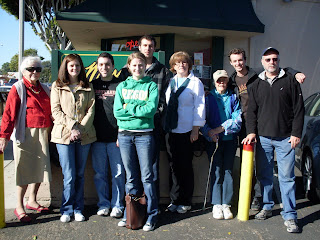
(From Left: Mrs. Whitney, Liz, Billy, Vickie, Patrick, Mom, Gramma, David, Uncle Dean)

After breakfast, Billy, Vickie, and I made the drive up to Lompoc, where we were going to be staying with my dad's parents, Mimi and Papa. It was fun pulling up to their house with Billy, because they have lived at 1124 N Gardenia since long before I was born. The tree out front that I crashed into when learning to ride a bike is gone, and they have replaced the blue shag carpet that was great for pick-up-stix, but it still feels like "home" to me.

After visiting with them for a while, Dad and Judy arrived, and Papa took us all on a tour of the Lompoc Valley. He took us up above the valley so we could look down on it, and he pointed out Vandenberg Air Force Base and the places from which they launch the rockets, some of which are affiliated with Billy's job. Driving around town with Papa is especially fun because he says things like, "I leveled the ground for this development," or "my crew carved out this mountainside to give clearance for the wings of the space shuttle when they towed it down the road." Billy got to see my Uncle Steve's farm and all the crops, too. We made a quick trip to a bar called Jasper's to visit with my (great) Aunt Betty before she left town. Outside, an older, homeless looking woman shuffled by, which struck me as strange because I have never in my life seen a homeless person in Lompoc (I thought they had all moved to Santa Barbara). Billy and I had to try to keep from laughing when, after she walked by, Papa said, "she was in my graduating class at Lompoc High," before pointing her out as Mimi's "friend," to which Mim said "she said hello to you, Donnie."

All of my dad's siblings still live in Lompoc, so it was a great chance to spend time with different family members. Our cousin Mackenzee is 13 now, and she was a lot of fun to have along throughout our visit. I kept my mouth shut about her plans to quit dance and stick with soccer but it was fun to hear her thinking through decisions like this on her own. Her brother Dalton is 16, so he was busy with friends while we were there, but he still made some time to come to family dinner at Mim's and stop by for some football. He says he wants to go to the University of Texas, so maybe this will finally give me an excuse to visit Austin. Their parents, my Aunt Kim and Uncle Craig, were great to see, and since Craig and Dalton weren't able to make it to Maryland for the wedding, I was really glad Billy was able to meet them. I was not surprised to find that Uncle Craig is also a Rob Dyrdek fan or that Billy noticed how unique my Aunt Kim's laugh is. : )

We also got to spend some time with Dad, Judy, Aunt Carrie, and Uncle Steve at Carrie and Steve's house. They just put in bar in their upstairs room, along with a 60" television, so this was the prime place to watch Navy destroy Missouri in their bowl game and to see Oregon fare less favorably in the Rose Bowl against Ohio State. Aunt Carrie also made dinner for us on New Year's Eve, including some fresh artichokes from Uncle Steve's farm and prime rib from the cow raised by one of Mackenzee's 4-H friends. (We didn't get to eat any of Luau, the pig Mackenzee raised from 30ish pounds to 240 pounds, though.) My Aunt Dana joined us for this dinner as well as the spaghetti dinner Mim had made the night before, and it was good to have a chance to hear what she has been up to lately.

I am very thankful that Billy and I got to stay with Mimi and Papa, who went out of their way to make us feel right at home, as always. Billy got to experience some of their bantering back and forth and their interjecting into one another's stories. These two have always cracked me up. I hope that when we are retired, Billy and I get to enjoy a life together like they have. This gives me about 30 years to convince Billy that we should get a motorhome, because right now, he is not enthusiastic about the idea. : ) Mim even made us breakfast every morning without mentioning the fact that when I was young, I called her velveeta macaroni and cheese "disgusting."

One moment that I think gave Billy a pretty good indication of my "family life" in Lompoc revolved around a discussion of Mike Leach, the now former head coach of Texas Tech's football team. The questions about whether or not he locked a player with a concussion into a dark room kept being discussed on the tv. Mimi and Papa kept talking about how unfortunate it was that this young man has brought down this coach's career when nobody really knows what happened. Papa pointed out that one of the other coaches called the player "uncoachable." Dad pointed out that Leach would have to be stupid to lock up that particular kid, because his dad works for ESPN. My Aunt Dana sided with the kid and was ready to condemn Leach, suggesting that they should "put him where they put Michael Vick." Then someone brought up the fact that earlier in the season, Leach said his players were doing poorly because they were spending time with their "fat little girlfriends." My Aunt Kim said that was awful, and everyone else agreed, and then after a pause, my Uncle Craig said, "Well, were they fat?" Kim shouted "Craig!", Mim said "well, that was not nice," and Billy and I cracked up.

This is life in the Chambers family, Billy. Welcome to it!!

("The Californian's Tale" is a short story by Mark Twain about California during its prospecting/ Gold Rush days.)

Tuesday, December 8, 2009

The Portrait of a Lady

My PhD application has been submitted!!! It is now officially out of my hands. Last I heard, there have been more than 200 applications submitted for a mere 6 spots.

All along, I have been repeating to myself (and Billy has been repeating to me) that all I could do was my best. I knew that in order to not feel like a failure, whether I am accepted or not, I would have to do everything I possibly could to strengthen my application. I can honestly say that I've done that, and that I believe my writing sample represents the best work I have done yet. In the future, I won't have to look back and think, "If I had only..."

So now, the waiting game begins. Last year, they notified accepted students on February 12.

I thought those of you who have followed along on this journey with me might like to read my "personal statement," which I had to submit to explain why I wanted to apply to the program. I paste that here for those who may be interested. I only ask that if you find any mistakes, you kindly never bring them to my attention. : ) How do you sum yourself up in fewer than 2000 words? This was the best I could do.

-----------------

In the final semester of my undergraduate program, I enrolled in a course called “Literature of the Great War.” I began to recognize that the post-war period was a remarkable time of literary production during which literature played an important role in the cultures of the countries involved. I couldn’t help feeling disappointed, though, that the only women’s works we read were a few excerpts from a collection titled Women’s Writing of the First World War, and that from the collection, my professor chose European women’s works exclusively. I began asking the types of questions then that continue to engage me now, five years later. What did the Great War mean to women who were U.S. Citizens? Why does there seem to be an assumption that women who were not in the trenches did not “experience” the war? How did American women represent their own war experiences in fiction? In what ways might the works of these women have influenced the lives of both men and women living in the United States? After teaching high school English for four years, I enrolled in graduate school to enhance my literary studies education and to return to working with these questions. I hope to have the opportunity to continue investigating this line of inquiry as a doctoral student at the University of Maryland.

Thinking through these questions about women's literature of the Great War has been one focus of my studies as a Master's student here at Maryland. In my first two semesters, I researched and wrote about Charlotte Perkins Gilman's Herland, the character of Éowyn in J.R.R. Tolkien's The Lord of the Rings, and Willa Cather's The Professor's House. Herland, written in 1915, depicts an all-female utopia that can be seen as Gilman's response to the conflict of the Great War, but the novel is not given much academic attention. I would like to begin working with other women writers whose work enjoyed wide readership after the war but is now rarely read, including the fiction written by Cather's good friend, Dorothy Canfield Fisher. Very few articles about Éowyn have been published, but by including her in his mythology, Tolkien demonstrates an understanding of how British women wrote about their Great War experiences. Working with these texts has encouraged me to consider the ways in which gender functions within these types of works and also how gender has impacted their critical reception. Cather's The Professor's House has helped me take my interest in “war” texts and extend it into considering questions about representation and aesthetics.

I have also begun conducting research about Katherine Anne Porter, whose depiction of the Great War in Pale Horse, Pale Rider motivated me to study her at more length. Within the University’s Katherine Anne Porter Collection, I have thus far focused on reading the marginalia Porter wrote in her books about the Great War and those written by Cather. Porter published writings about Cather and both World Wars, and I have found that her marginalia elaborates in interesting ways upon the attitudes she documented in print. The collection's curator, Dr. Beth Alvarez, has been enthusiastic about helping me with this research. I anticipate that Porter will be an important figure in the work I'd like to do concerning women's Great War writing, and acceptance into the doctoral program at Maryland would allow me to continue working with Dr. Alvarez to conduct research on Porter that cannot be done anywhere else.

While I continue to focus on the ways women wrote about the Great War, I have also endeavored to ensure that my literary studies education is comprehensive. In addition to pursuing classes that meet the M.A. distribution requirements, I enrolled in the Introduction to the Discipline course that Dr. Chuh began offering this year. Learning about the concerns that are currently driving research in our professors' various specialties has helped me to think about ways that my work can engage with other fields. Dr. Kirschenbaum's presentation, in particular, has encouraged me to find out how I might be able to incorporate the Digital Humanities into my own research. I have also focused on strengthening my understanding of critical and literary theory, to which I had very little exposure as an undergraduate. In my first semester, I took English 602 with Dr. Chuh, which helped me establish a general foundation in critical theory and literary criticism across different time periods. I have enrolled in the Critical Theory Colloquium for the past two semesters, and I intend to continue participating in this conversation as long as I am a student at Maryland. It has helped me begin to "think more theoretically" and has exposed me to the theoretical approaches that other graduate students are working with on campus. In my second semester, I took Cultures of Theory with Dr. Richardson and developed an interest in narrative theory that has also helped me to engage literary texts with new perspectives. The Aesthetic Inquiry seminar I am taking this semester with Dr. Chuh attracted me, in part, because of its engagement with theoretical texts. I have always been a careful close reader and have enjoyed conducting secondary research. By studying critical and narrative theory, I am challenging myself to apply those skills to the consideration of questions that are larger than the scope of a single novel or time period.

The writing sample I am submitting, Seeking a Sensible Memorial, represents the various concerns I have been pursuing as a graduate student. After writing about Cather's The Professor's House last spring, I began researching the correlation between this novel and Cather’s earlier “war” novel, One of Ours, with the guidance of Dr. Mallios. During Dr. Chuh's seminar, I decided to apply theoretical pressure to the conclusions I was forming about these two texts. The end result, I believe, demonstrates the ways in which my engagement with historical research and critical theory allows me to examine and interpret literary texts in original ways. I am very excited about my findings, but because I have been working on this paper all semester, the feedback I've gotten from professors has been limited to the conversations I've had with them about my project. I intend to use the criticism Dr. Chuh and Dr. Mallios provide to develop this writing sample into my Master’s writing project. While I believe I've identified a plausible explanation for why Cather changes her artistic techniques from one novel to the next, I hope to examine in more depth how her gender and the stereotypes of narratives written by women versus narratives written by men might have informed this decision. Although I have not yet had the chance to study with Dr. Lindemann, who has been on leave this semester, her writings on Cather have helped to inform my own perspective, so I hope to have the opportunity to work with her in the future, as well.

While strengthening my own education has been the focus of much of my graduate study, I am also deeply devoted to the practice of teaching. I genuinely enjoyed the four years I spent as a high school English teacher in southern Maryland, and I left the profession only because the state's testing requirements interfered with my ability to choose my own teaching methods. I care a great deal about ethical pedagogy, and it became increasingly difficult for me to stand in front of students and ask them to memorize only those skills that would be assessed on the state test. I believe my teaching experience has given me a perspective on literary studies that enhances my thinking and forces me to constantly consider the implications of different teaching practices. I am deeply invested in developing new and better ways to illuminate the subject matter for my students while encouraging them to think critically. These interactions with my students also further my own intellectual development. Taking Approaches to College Composition in my first semester helped me begin to think about the ways I can apply my teaching experience to the college classroom. I am confident that teaching within the First Year Writing Program and working with the faculty members here at Maryland would be invaluable to me as I move forward in my career as an educator.

Since I began thinking about applying to the Ph.D. program, I have taken advantage of every opportunity I could find in order to ensure that this was best "next step" for me. In addition to my Katherine Anne Porter research, and the non-required courses in which I have enrolled, I have been working on branching out within the academic community. Dr. Flieger suggested that I consider seeking publication for my seminar paper, so as a first step, I submitted it to the CUNY Graduate Center’s conference for consideration. Dr. Richardson also recommended that I revise the paper I wrote in his class for publication, and I was pleased that it was accepted for the Publications Workshop this semester. Being the only MA student in a workshop with Dr. Auerbach and peers who are several years farther along in their studies has been a remarkable opportunity to become a stronger thinker and writer. The International Society for the Study of Narrative has already accepted this paper for presentation at their yearly conference this spring, and I have also submitted it to the GEO conference for consideration. I intend to use the very helpful feedback provided by Dr. Auerbach and my classmates to help me revise the paper over the winter break so that it is ready to be presented and submitted for publication.

It has also been important to me to make sure Maryland was a place where I wanted to continue to study. To this end, I accepted the GEO President's request to serve as one of the graduate student Departmental Assembly representatives, and I have attended every meeting the graduate program has held about the future of the department and the program. These meetings have given me faith in the graduate program, because despite the obstacles it currently faces, I am convinced that the faculty members are deeply committed to preserving its integrity. My positive interactions with professors both in my courses and in my work as a Graduate Assistant in the Main English Office also persuade me that Maryland will continue to be an excellent place at which to study English.

All of these pursuits have placed significant demands upon my time beyond the hours I've devoted to the rigorous workload I carry as a Maryland M.A. student. I always feel like there is more work to do than time in which to do it, but these endeavors continue to reaffirm my conviction that I want pursue my Ph.D. here. Rather than wishing I had less work to do, I always find myself wishing I had more time to do the work that sustains me. I sincerely believe it is a privilege to be an English graduate student, particularly at the University of Maryland, and I have always taken that privilege very seriously. I hope I have demonstrated through my commitment to thinking, learning, researching, and teaching that I am qualified to continue my studies as a doctoral student.

---------------

(The Portrait of a Lady is Henry James's story of a young American woman trying to find her way in Europe. I knew things did not turn out well for her, so I did not expect to like it, but I loved it. Thanks, Dr. Auchard.)

Saturday, December 5, 2009

A Jury of Her Peers

Let's face it: academics sometimes give themselves a bad reputation. Working in the office of a nationally ranked English department, I've seen the good, the bad, and the ugly. There are quite a few professors who are genuinely kind, appreciative, thoughtful people. There are some who think they are more important than those of us working in the office, and whose air of superiority is hard to miss. And then there are those who make it clear that they think they come from some kind of superior stock. I've actually heard this phrase uttered: "Don't you know who I am?" It doesn't matter who you "are": the answer to this question is always the same. If you're asking it, you're an asshole. In this environment comprised of individuals with vastly different egos, blazing a path for myself as timesheet approver/paycheck sorter/graduate student has been generally rewarding but sometimes unbelievably upsetting. Anytime I come across a successful academic who seems like a sincere, thoughtful, kind person, I find it exceptionally refreshing. Such was the case yesterday afternoon when Elaine Showalter came to campus to speak about her new book.

There are few academics who are more successful than Elaine Showalter. I know of her because I've read excerpts from her wildly successful Teaching Literature. I've heard about but haven't yet read A Literature of Their Own. Upon finding out that she was going to be speaking about her latest project, A Jury of Her Peers: American Women Writers from Anne Bradstreet to Annie Proulx, I knew I had to go. It didn't matter that I didn't have time on an afternoon four days before my PhD application was due, or that it would force me to sit in miserable Friday evening rush hour traffic: I had to go.

A Jury of Her Peers is the first comprehensive literary history of American women writers. Showalter wrote the entire thing herself. And somehow, while talking about the topic I have been slaving away with the hopes of continuing to study for the next four years, she managed to calm a lot of the fears I have about diving into the pool of sharks that academia sometimes feels like.

She said to be confident in your opinion, and to assert it with conviction, but to expect that no one will agree with you. This will keep you confident and humble.

She said that professors should consider teaching to be the most important thing they do, even more important than their own research. (I hope some of our professors were listening.)

She said that literary anthologies, in an attempt to accomodate more writers, and more points of view, and to break down the literary canon, have gotten too large to be manageable and have thus become "editorial octomoms." (Did I mention that she made waves in academia by writing for People Magazine and Vogue?)

She said that each person should feel comfortable declaring their own point of view, and that by staking a definitive claim, we create a space where our critics can think seriously and generatively about why they disagree with us.

She said that women should not be afraid to "Make a little trouble, make a little space."

And she reminded me that the work I'm doing, and the work I want to do, is important. Hemingway and Dos Passos and Fitzgerald are exceptional, but so are Cather and Porter and Canfield Fisher. And they still don't get enough attention. And their narratives still aren't recognized by much of academia, not to mention mainstream America.

For several weeks, I've been trying to find my second wind. Thanks, Dr. Showalter, for blowing into town with brilliance and humor to fill my sails.

Want to know more about the book? Elaine Showalter discusses it here.

----

In other news, Clara Hoffmann turns 1 today! It's hard to believe how much the little bug has changed in just a year!


And my college roommate, Jolene, gave birth just after midnight to Jacob Carl Clearwater. Welcome to the world, Jacob! December 5 is a good day to be born!

Friday, November 6, 2009

The Awakening

My dad says, "Just keep playing." In The Old Man and the Sea, Santiago goes out in that boat every day, 84 times in a row, until he catches that fish.

This morning, on my way into work, I had an epiphany. I can use the research I've been doing on Cather for my writing sample and re-direct it slightly to serve as the paper for the seminar I'm taking this semester. This solves the two major problems of my semester; I don't have time to complete all these papers well, and I had no idea what to write my seminar paper about.

This deserves its own blog post. Consider it the digital equivalent of a sigh of relief.

(The Awakening by Kate Chopin is the story of a young mother's realization that she does not have to live the life society has assigned to her. I assure you my own awakening, however, will not conclude with my death.)

Wednesday, November 4, 2009

The Elements of Style

This has been my expression for the past two and a half days:


I've been thinking about the relationship between Cather's The Professor's House and One of Ours since April. I've been actively researching it since August. The deadline for my PhD application is just over a month away, so I've been writing about it for the past two days and a half days.

In that time, I've put together 9.5 single spaced pages. An entire first draft, minus introduction and conclusion. I still have to figure out how to boil it down to about 8 pages, intro and conclusion completed. But I feel pretty good about it. Most of all, I feel good that these two and a half days are behind me.

I do love to write. Tonight on "Modern Family," one of the themes was finding something that you do the best. This is the thing that I do the best. I hope this paper is good enough to give me the chance to keep doing it.

(The Elements of Style by William Stunk and E.B. White is a must-own for anyone who takes writing seriously.)

Thursday, October 29, 2009

Everything That Rises Must Converge

On Monday, I turned in my final "mid-term" paper. It wasn't my best work, but it was the best I could do before that due date. This meant that on Tuesday, I could return more seriously to trying to write the Cather paper that will be used as my PhD writing sample. This paper has been coming together in my head for about 7 months, and now all I have to do is some concluding research before I can sit down to write it. I am ready to be done with it already, but I am excited to see how it will turn out. I have put a lot of thinking into it, and even if it doesn't get me into the PhD program, I will be glad that I spent time trying to produce the best paper I'm capable of writing.

Also on Tuesday, I received a letter from Willa Cather. It wasn't written to me, obviously (it was the Mencken letter I wrote of earlier), but it felt like it might as well have been. She describes what she was trying to do with One of Ours, and this complements the arguments I'm trying to make. There is also an unusual excitement that people like me get from seeing these "authentic," personal thoughts written by novelists we greatly admire. Literary critics will argue back and forth about whether a text has an "aura" or not, but when I sit down with a photo copy of a letter Cather wrote in 1922, or read the notes that Katherine Anne Porter wrote in the books she read for pleasure, it is an exciting feeling. With the Porter books, it almost feels like the notes have been written to me, because some of them were written after she had agreed to donate her books to UMd. Sometimes it feels like she writes things that she was hoping someone who is interested in her MIGHT find somewhere down the road. With Cather, it is quite the opposite, because she was so protective about her personal thoughts. It's exciting to be reading them, but it also feels kind of wrong, because I know she would object to this invasion of her "privacy."

Every time, I find that eventually the different things I'm working on come together. Some of the ideas I've been researching fall away and the ones that are most important rise to the top. I'm really excited about writing this paper, which is helping to get me through the mountains of other work I have piling up as we speak. I took on a lot this semester, and with about 6 weeks left, I'm already ready for it to be over. But Mrs. Murray, my 10th Grade English teacher, once told me that "the only way out is through." I can't remember how this came up, or what book it might have related to, but I've carried it with me. There's no way to get around all this work I have to do-- all I can do is to accomplish, every day, as much as I can. Eventually, I'll be through to the other side.

(Everything that Rises Must Converge is Flannery O'Connor's final short story collection. In the title story, a young man struggles with relating to his mother. The title is also a reference to the work of Pierre Teilhard de Chardin, and it is furthermore the name of an artistic installation created by Sarah Sze.)

Wednesday, October 21, 2009

Menckenia: A Schimflexikon

Since we got back from Michigan, Billy and I haven't been up to much. He has been sick, and I have been reading. Our softball game was cancelled again (what does the weather have against our softball team?), we joined the gym, and my Nike+ sensor continues to be broken. I'm not hassling with a new one; the new Nano is built for working out. It has the Nike+ equipment all built into it, so I will no longer have to wear the sensor clipped to my shoe, and it has an FM tuner, so I will be able to tune in the sound for the TVs in the gym. It is really only a matter of time before I buy one, but until then, my mini will be complaining that I she hasn't had a workout. I am getting close to the 500 mile mark for the year, which is pretty unbelievable.

The only thing of interest that happened to me last week regards my PhD writing project. I'm looking at Willa Cather's novel, The Professor's House, as a sort of re-writing of her "war" novel, One of Ours. Instrumental to this project are two H.L. Mencken artifacts, so I can prove, essentially, that Mencken read the book incorrectly.

Prior to the publication of OoO, Cather wrote a letter to H.L. Mencken explaining what she was trying to do with the novel and asking him to review it. I have read several different summaries of this letter, but her will prevents all scholars from directly quoting her personal correspondence (this runs out in 2012- can't wait!). One of the summaries says that she wrote something to suggest that "it is not a sentimental novel." I must read this myself so that I can see what she actually said and because I might be able to re-paraphrase it to support my argument. Most of her letters are at the University of Nebraska, and they have never reproduced them, so you can't see them on microfilm or anything. However, through my research, I discovered that this letter is one that Mencken kept, so it is in the H.L. Mencken collection at the Enoch Pratt Free Library in... Baltimore!! I called the curator with hopes of visiting the H.L. Mencken room and seeing the letter for myself, but the Mencken room is never actually open, so he is going to send me a photocopy. I am half expecting to get a call back from him telling me that he realized he is not actually allowed to do this, but hopefully I will receive the photocopy before that phone call.

The other thing I need to see firsthand is the review Mencken wrote. I've read a few quotations from it, and it seems to me a particularly sexist review, because he says it fails because it's not as good as Dos Passos's Three Soldiers, and that it reads like a story for "Ladies Home Journal." The review was published in a 1922 issue of "The Smart Set," which much to my dismay, is not available online anywhere. The Philadelphia Public Library has the whole run of the magazine available on Microfilm, but I didn't see anything on their website about how to request a photocopy of a microfilm. I enlisted the help of the English research librarians, who discovered that there is an available copy of the precise issue I need on my VERY OWN CAMPUS! One of the previous presidents of the Mencken Society donated his random collection of Mencken materials to UMd and it includes the issue of The Smart Set that is supposed to contain the Cather review. I'm going to look at it this afternoon.

I have geeked out considerably about the discovery that I will actually be able to see these two documents myself. This reinforces my feeling that the PhD is the right path for me; a PhD in English is, quite simply, a research degree. As an undergraduate student, I tried to avoid research at all costs, but now, the thrill of the hunt is part of the fun. Now I just have to figure out how to inject the sense of this thrill into my personal statement!

(Menckeniana: A Schimpflexikon is a volume released by Mencken in 1928. In it, he presents a selection of articles and quotations, written by others, that criticized him in print. I believe his intention was to poke fun at these individuals, whereas my criticism of him will be, of course, wholly legitimate. : ))